
Semantic SEO Expert
I build entity-based topical maps using the EAV model and Koray’s framework, covering the full funnel with strategic internal linking.
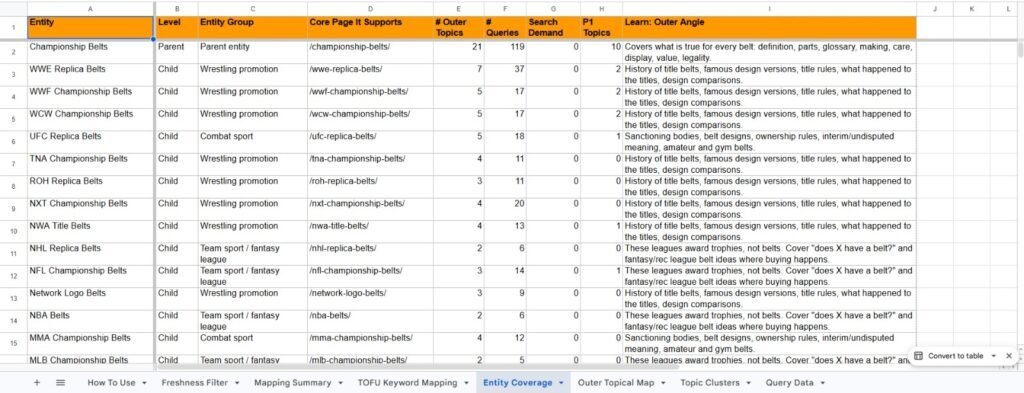
My Semantic SEO Process
Every project follows the same six-step framework. Each step feeds the next, so nothing on your website is published without a reason or a place in the bigger structure.
- Find the central entity – identify the core entity and the source context of your business.
- Build an EAV-based topical map – break the entity into attributes and values, then turn them into topics.
- Structure it with Koray’s framework – split the map into core and outer sections with a clear contextual hierarchy.
- Map the full SEO funnel – assign every topic to TOFU, MOFU or BOFU intent.
- Publish with planned frequency – release content in a rhythm that builds topical momentum.
- Connect it with strategic internal linking – pass relevance and link equity to the pages that matter most.
Step 1: Finding the Central Entity and Source Context
Every strong topical map starts with one question: what is this website really about? I identify the central entity, the main “thing” your business revolves around, and the source context, which is how your business earns from that entity.
For example, two websites can share the central entity “coffee”. One sells espresso machines, the other teaches home brewing. Their source context is different, so their topical maps, page priorities and search intents must be different too.
At this stage I define:
- Central entity – the core topic every page connects back to
- Source context – the commercial angle that shapes what the site should rank for
- Central search intent – the main need users have when they search around that entity
- Competitor entity gaps – the attributes and sub-topics competitors miss or cover weakly
Step 2: Building an EAV-Based Topical Map
Once the central entity is clear, I break it down with the Entity–Attribute–Value (EAV) model. This is the same way search engines store facts in their knowledge graphs, so content built on it matches how they understand a topic.
- Entity – the thing being described
- Attribute – a property or characteristic of that entity
- Value – the specific data for that attribute
| Entity | Attribute | Value |
|---|---|---|
|
Espresso machine |
Type |
Manual, semi-automatic, super-automatic |
|
Espresso machine |
Pressure |
9 to 15 bar |
|
Espresso machine |
Boiler |
Single, dual, heat exchanger |
|
Espresso machine |
Maintenance |
Descaling, backflushing, gasket replacement |
Each attribute becomes a topic or a section, and each value becomes the facts that page must answer. I prioritize attributes in three layers:
- Root attributes – define the entity itself; every competitor covers them
- Rare attributes – specific details few competitors cover, which create information gain
- Unique attributes – details only your business can speak about with authority
The result is a topical map where no important attribute is missing and every page has a clear job.
Step 3: Structuring the Map with Koray's Framework
I structure every topical map using Koray Tuğberk GÜBÜR’s holistic SEO framework. It turns a long list of topics into an organized semantic network that search engines can crawl, understand and trust.
- Core section – pages tied directly to your source context and revenue, such as services, products and comparisons
- Outer section – supporting pages that cover the wider context of the entity and build authority for the core section
- Contextual hierarchy – a clear parent–child order, so broad topics sit above specific ones
- Contextual borders – each page stays focused on one macro context, with no overlap or cannibalization
- Contextual bridges – planned connections between related topics so meaning flows across the site
- Macro and micro contexts – one main purpose per page, with supporting sub-sections that answer related questions
- Query semantics – headings and answers written to match how users phrase their questions
Step 4: Mapping the Full SEO Funnel
A topical map only drives revenue when it covers the whole buyer journey. I assign every topic to a funnel stage, so the site attracts visitors, educates them and converts them, all inside one connected structure.
| Funnel stage | Search intent | Page types | Example topic |
|---|---|---|---|
|
TOFU (Top of Funnel) |
Informational: learning and discovering |
Guides, definitions, “what is” and “how to” articles |
What is a semi-automatic espresso machine? |
|
MOFU (Middle of Funnel) |
Commercial investigation: comparing options |
Comparisons, best-of lists, buying guides, reviews |
Semi-automatic vs super-automatic espresso machines |
|
BOFU (Bottom of Funnel) |
Transactional: ready to act |
Service pages, product and category pages, pricing |
Buy a dual boiler espresso machine |
TOFU pages build authority and reach. MOFU pages build trust. BOFU pages convert. Internal links guide users and crawlers from the top of the funnel down to the pages that earn money.
Step 5: Publishing with Planned Frequency and Topical Momentum
Topical authority is not built by publishing once and waiting. Search engines watch how consistently a website expands and maintains its coverage of a topic. I plan a publishing rhythm that creates topical momentum.
- Planned order – core pages and their closest supporting pages go live first, so the main structure is complete early
- Steady frequency – new content is released in a consistent rhythm, signaling an active, specialized source
- Cluster completion – one sub-topic is fully covered before moving to the next, so each cluster gains authority on its own
- Content refresh – existing pages are updated with new attributes and facts to keep historical data positive
This rhythm tells search engines your website is specializing in the topic, not just touching it.
Step 6: Strategic Internal Linking
Internal links are what turn separate pages into one topical map. I plan every link based on the map’s contextual hierarchy, so relevance and link equity flow to the right pages.
- Outer to core – supporting articles link up to the core pages they support, passing authority toward revenue pages
- Parent to child – broad pages link down to their specific sub-topics, helping crawlers discover depth
- Sibling links – closely related pages connect through contextual bridges, not random “related posts”
- Descriptive anchor text – anchors name the entity or attribute of the target page, giving search engines a clear signal
- Link placement – the most important links sit in the main content, close to the relevant context
- No orphan pages – every page in the map is reachable and connected
The outcome is a site where every page supports another, and the whole topic cluster ranks together.
More Semantic SEO Tactics I Apply
- Semantic content briefs – every writer gets the entity, attributes, questions, heading order and internal links for the page
- Information gain – content adds facts, data and angles competitors don’t have
- Structured data – schema markup that tells search engines exactly which entities a page is about
- Entity consistency – the same names, definitions and facts across the whole website
- Cannibalization control – one page per search intent, with clear borders between topics
- E-E-A-T signals – author entities, sources and real experience built into the content
Tools I Use
The right tools turn a topical map from a theory into measurable results. I use each one for a specific job in the semantic SEO process.
| Tool | How I use it |
|---|---|
|
Semrush |
Keyword and topic research, competitor gap analysis, site audits and position tracking |
|
Ahrefs |
Backlink analysis, content gap discovery and finding the pages that drive competitors’ traffic |
|
Google Search Console (GSC) |
Query and page performance, indexing checks, cannibalization detection and finding new sub-topics from real impressions |
|
Google Analytics 4 (GA4) |
User behavior, engagement and conversions across TOFU, MOFU and BOFU pages |
|
Google Tag Manager (GTM) |
Event and conversion tracking without code changes, such as CTA clicks, form submits and scroll depth |
|
Google Keyword Planner |
Search volume and commercial value for BOFU and MOFU topics |
|
Ubersuggest |
Quick keyword ideas, question-based queries and content suggestions |
|
Claude |
Entity and attribute extraction, EAV mapping, topical map structuring and semantic content briefs |
|
Screaming Frog |
Technical crawls, internal link audits and finding orphan pages |
|
Google NLP API |
Checking which entities Google detects on a page and how salient they are |
|
Schema Markup Validator & Rich Results Test |
Validating structured data before and after publishing |
|
Google Sheets |
Building and managing the topical map, publishing plan and internal linking blueprint |
What You Get
- Semantic content briefs – every writer gets the entity, attributes, questions, heading order and internal links for the page
- Information gain – content adds facts, data and angles competitors don’t have
- Structured data – schema markup that tells search engines exactly which entities a page is about
- Entity consistency – the same names, definitions and facts across the whole website
- Cannibalization control – one page per search intent, with clear borders between topics
- E-E-A-T signals – author entities, sources and real experience built into the content
| Deliverable | What it includes |
|---|---|
|
Entity and source context analysis |
Central entity, source context, central search intent, competitor gaps |
|
EAV-based topical map |
All topics, organized into core and outer sections with a clear hierarchy |
|
Funnel mapping |
Every topic labeled TOFU, MOFU or BOFU with its search intent |
|
Publishing plan |
Content order and frequency for building topical momentum |
|
Internal linking blueprint |
Source page, target page and anchor text for every planned link |
|
Semantic content briefs |
Ready-to-write briefs for each page in the map |
Ready to Become the Authority in Your Niche?
Let’s map your central entity, find the gaps your competitors miss and build a topical map that grows your rankings topic by topic.