
AEO Specialist
I get brands cited by AI answer engines through external topical maps, third-party consensus and fan-out query content.
My AEO Process
My AEO framework works on two topical maps at once: an external map that shapes what the web says about you, and an internal map that makes your own content the easiest source to cite.
- Define your money attributes – decide exactly what AI should say about your brand.
- Build an external topical map – place those attributes on third-party sources for links, mentions and positive claims.
- Earn consensus on UGC platforms – make your brand part of real community discussions AI learns from.
- Write fan-out query content – cover every sub-question an answer engine generates for your topic.
- Make every answer extractable – format and mark up content so AI can lift and quote it.
- Track AI visibility and iterate – measure citations and close the gaps.
Step 1: Defining Your Money Attributes
Before building anything, I decide what AI should say about your brand. These are your money attributes: the specific qualities that make people choose and pay for you.
- Brand entity – a clear, consistent definition of who you are, what you do and who you serve
- Money attributes – the claims that drive sales, such as “best for small clinics”, “fastest delivery in Lahore” or “most affordable plan”
- Prompt mapping – the real questions buyers ask AI tools, like “best X for Y” or “X vs Y”
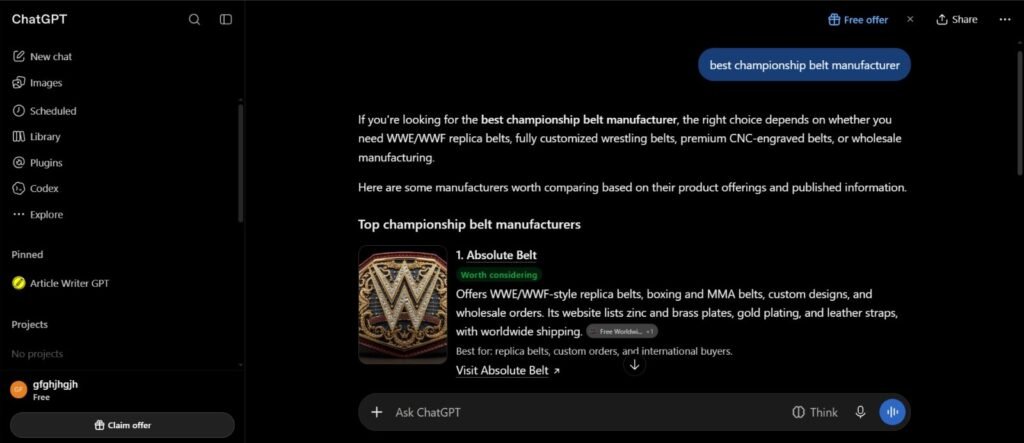
- Current AI perception – what ChatGPT, Gemini and Perplexity say about you and your competitors today
Every later step pushes these same attributes, so AI hears one consistent story from every source.
Step 2: Building the External Topical Map
AI answer engines trust what independent sources say about you more than what you say about yourself. So I build an external topical map: a planned set of third-party placements, each one carrying your money attributes into a relevant context.
Each placement is designed to deliver three things:
| Outcome | What it means | Why AI cares |
|---|---|---|
|
Link |
A contextual backlink to the relevant page
|
Passes authority and helps crawlers connect sources to your site
|
|
Mention |
Your brand named alongside the topic, even without a link
|
Builds co-occurrence between your brand and the topic in AI training and retrieval data
|
|
Claim / positive sentiment |
A positive statement tied to a money attribute
|
Gives AI a quotable reason to recommend you |
Third-party sources I target include industry publications, niche blogs, listicles and “best of” roundups, comparison sites, review platforms, directories, podcasts, digital PR and expert quotes in news articles.
Like an internal topical map, the external map follows the entity’s attributes. Each placement covers a different attribute, so the web as a whole describes every important side of your brand.
Step 3: Earning Consensus on UGC Platforms
Large language models lean heavily on user-generated content. Reddit threads, Quora answers, YouTube comments, LinkedIn posts and niche forums show AI what real people think. When many independent voices agree on something about your brand, AI treats it as consensus.
I build that consensus through genuine participation:
- Find the threads that matter – the discussions AI engines already cite for your topic
- Show up as a real expert – helpful answers from your team’s verified accounts, with transparent brand affiliation
- Activate real customers – make it easy for happy customers to share honest experiences and reviews
- Keep the story consistent – the same money attributes appear naturally across platforms
- Handle negative sentiment – respond to complaints publicly and fix the root issue
Authentic consensus lasts. Fake accounts and paid reviews get removed by moderators, break platform rules, and can damage how AI describes your brand.
Step 4: Writing Internal Content with Fan-Out Query Paragraphs
When someone asks an AI engine a question, it doesn’t run one search. It breaks the question into many related sub-queries, called query fan-out, and builds its answer from passages that answer each one. I write your internal topical map articles around those sub-queries.
For the prompt “best CRM for a small real estate agency”, an answer engine may fan out into:
- What features does a real estate CRM need?
- How much does a CRM cost for a small team?
- Which CRMs integrate with property listing portals?
- Is CRM X or CRM Y better for real estate agents?
- What do real users say about CRM X?
How I write fan-out content:
- Map the fan-out – list every sub-query an answer engine is likely to generate for each topic
- One paragraph per sub-query – each paragraph answers one question completely and stands on its own
- Answer first – the direct answer opens the paragraph, then supporting detail follows
- Weave in money attributes – your brand’s strengths appear where they are genuinely relevant
- Add unique facts – data, prices, examples and first-hand experience that AI can’t find elsewhere
Self-contained, fact-rich passages are exactly what retrieval systems pick up and cite.
TOFU pages build authority and reach. MOFU pages build trust. BOFU pages convert. Internal links guide users and crawlers from the top of the funnel down to the pages that earn money.
Step 5: Making Every Answer Extractable
Great content still gets skipped if AI can’t parse it. I structure each page so answer engines can find, lift and quote the right passage.
- Question-based headings – H2 and H3 headings phrased the way users ask
- 40–60 word direct answers – short, complete answers right under each heading
- Lists and tables – comparisons, steps and specs in formats AI extracts easily
- Structured data – Organization, Product, Service, FAQPage, HowTo and Review schema
- Entity clarity – consistent brand name, sameAs links and an About page that defines your entity
- Crawl access – robots.txt and server settings that allow AI crawlers such as GPTBot, PerplexityBot and Google-Extended
- Freshness – visible update dates and regularly refreshed facts
Step 6: Tracking AI Visibility and Iterating
AEO is measured differently from SEO. I track how often and how positively AI engines mention your brand, then close the gaps.
| Metric | What it shows |
|---|---|
|
Brand mention rate |
How often your brand appears in AI answers for your target prompts |
|
Citation rate |
How often your pages are linked as a source |
|
Share of voice |
Your mentions compared with competitors for the same prompts |
|
Sentiment |
Whether AI describes you positively, neutrally or negatively |
|
Attribute accuracy |
Whether AI repeats your money attributes correctly |
|
AI referral traffic |
Visits from ChatGPT, Perplexity, Gemini and Copilot in analytics |
More AEO Tactics I Apply
- Knowledge graph presence – Google Business Profile, Wikidata where eligible, and consistent profiles across directories
- Comparison and alternatives pages – honest “X vs Y” and “alternatives to X” pages that AI uses for recommendation prompts
- Original data and research – surveys, stats and studies that other sites and AI engines cite
- Author entities – real experts with bios, credentials and profiles that build E-E-A-T
- Video and podcast transcripts – indexed content on YouTube and podcast platforms that AI also reads
- Semantic SEO foundation – a strong internal topical map that gives AI a complete, trusted source to cite
Tools I Use
AEO needs two kinds of tools: ones that show what AI engines say about your brand, and ones that help shape it. Each tool below has a specific job in my process.
| Tool | How I use it |
|---|---|
|
ChatGPT, Gemini, Perplexity & Copilot |
Manual prompt testing to see which brands, sources and attributes each engine recommends |
|
Claude |
Mapping query fan-out, extracting money attributes and writing fan-out content briefs |
|
Semrush (AI visibility tools) |
Tracking brand mentions and share of voice in AI answers, plus competitor and keyword research |
|
Ahrefs (Brand Radar) |
Monitoring brand mentions in AI answers and finding the third-party pages competitors are cited from |
|
Google Search Console (GSC) |
Tracking performance in Google search, including queries that trigger AI Overviews |
|
Google Analytics 4 (GA4) |
Measuring AI referral traffic from ChatGPT, Perplexity, Gemini and Copilot with a custom channel group |
|
Google Tag Manager (GTM) |
Tracking conversions from AI-referred visitors |
|
Google Keyword Planner & Ubersuggest |
Finding question-based and commercial queries to build prompt maps |
|
AlsoAsked & AnswerThePublic |
Discovering the follow-up questions users ask around a topic |
|
Reddit, Quora & forum search |
Finding the UGC threads AI engines cite and where consensus is formed |
|
Brand24 / Google Alerts |
Monitoring new brand mentions and sentiment across the web |
|
Schema Markup Validator & Rich Results Test |
Validating Organization, FAQPage, Product and Review schema |
What You Get
| Deliverable | What it includes |
|---|---|
|
AI visibility audit |
How AI engines describe you and your competitors today
|
|
Money attribute and prompt map
|
The claims to own and the prompts buyers use |
|
External topical map |
Target third-party sources, each tied to an attribute and outcome |
|
UGC consensus plan |
Platforms, threads and a participation plan for your team |
|
Fan-out content briefs |
Sub-queries and paragraph plans for each article |
|
Technical AEO checklist |
Schema, crawler access and entity setup |
|
Monthly AI visibility report |
Mentions, citations, share of voice and sentiment |
Is AI Recommending Your Competitors Instead of You?
Let’s find out what ChatGPT, Gemini and Perplexity say about your brand today, and build the plan that makes you the answer.