
SEO Case Study: AbsoluteBelt.com
Project Snapshot
- Website: absolutebelt.com
- Industry: E-commerce (Championship belts)
- Starting point: Brand-new domain with no authority or search history
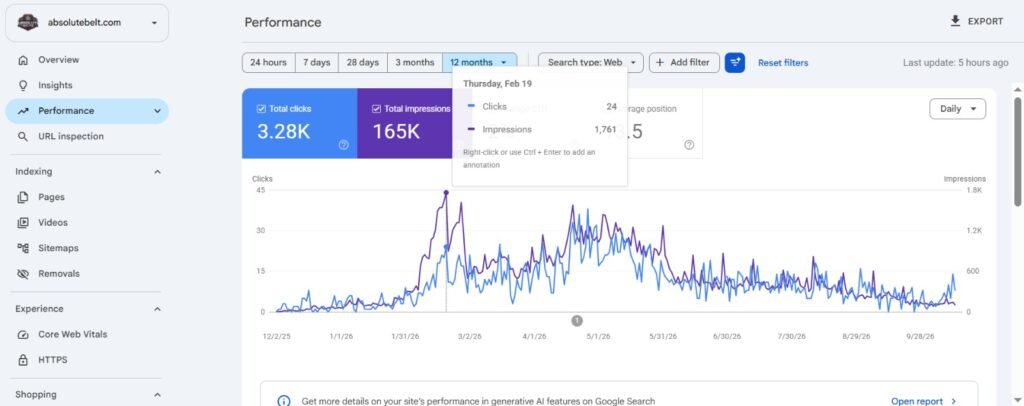
- Data source: Google Search Console, Web search type, last 12 months (Dec 2025 to Oct 2026)
- 12-month totals: 3.28K clicks, 165K impressions, 2% average CTR, 13.5 average position
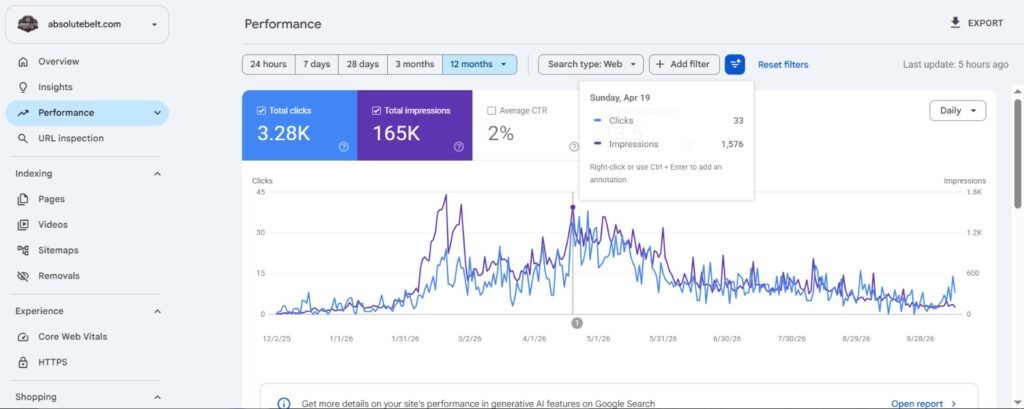
- Peak days: Feb 19 (24 clicks, 1,761 impressions) and Apr 19 (33 clicks, 1,576 impressions)
Executive Summary
AbsoluteBelt.com went from zero visibility to more than 160K impressions in its first year using straightforward on-page SEO. Along the way it hit three problems: slow page speed, inconsistent business details (NAP) across the web, and later a quality problem caused by thin content and illogical internal linking. Each problem showed up clearly in the Search Console graph, and each fix was followed by a recovery. The site is now in a third growth phase, driven by content rewriting and a topical cluster strategy.
Phase 1: Launch and Early Growth (Dec 2025 to Mar 2026)
Situation. The site was new, with no rankings and almost no impressions.
What we did. We applied simple, foundational on-page SEO:
- Keyword-targeted titles and meta descriptions
- Optimized headings and product/category copy
- Clean URL structure and basic internal links
Result. Impressions began climbing from January and reached roughly 1.8K per day by mid-February. Clicks followed, peaking at 24 on Feb 19 and 33 on Apr 19. This proved the niche had demand and that the site could rank with good fundamentals.
Phase 2: Technical and Trust Problems
Problem 1: Slow website speed
A large number of product pages had been added, and the site’s speed suffered. Slow pages hurt user experience, Core Web Vitals, and crawl efficiency.
Problem 2: Inconsistent NAP
The Name, Address, and Phone details on the website did not match those on the Google Business Profile (GBP) and social media profiles. Inconsistent entity data weakens local trust signals and confuses search engines about which details are correct.
Fixes
- Improved page speed (image optimization, caching, and reducing page weight) [add the specific actions you took]
- Standardized NAP across the website, GBP, and all social profiles
Result. After these fixes, traffic began growing again day by day.
Phase 3: The Second Decline (May to Sept 2026)
Symptoms
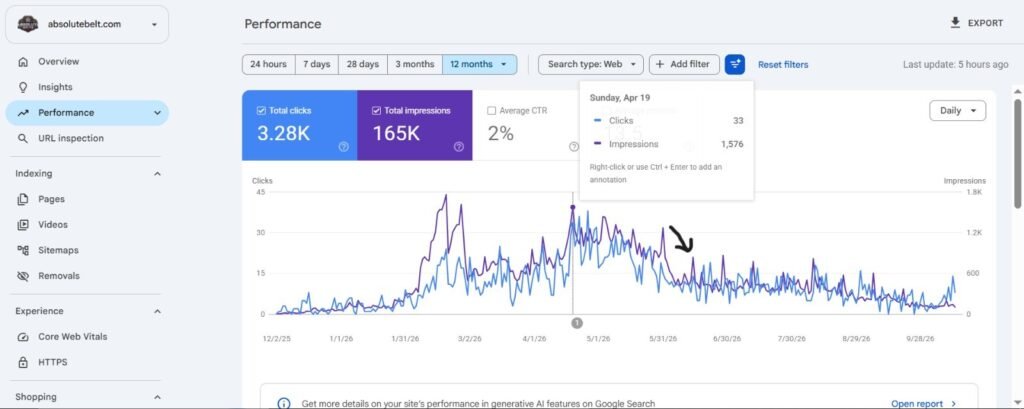
From May onward, clicks and impressions trended down to a much lower daily baseline, even though the earlier technical issues had been resolved.
Audit findings
- Low-quality content beyond the product pages. The supporting sections of the site (outside the product pages) had thin, weak content, similar to the product pages.
- Illogical internal linking. Links did not follow a clear topical structure, so page relationships and authority flow were unclear to both users and search engines.
Takeaway
Fixing technical issues is not enough on its own. Content quality and site architecture decide whether growth lasts.
Phase 4: Content Recovery Strategy (Current)
The current work focuses on quality and structure:
- Content rewriting: Replacing thin pages with useful, intent-matched content
- Deindexing product page URLs: Removing low-value product URLs from the index so crawl budget and quality signals concentrate on pages that matter
- Slug clean-up: Setting clear, keyword-relevant, consistent URL slugs
- On-page optimization: Updating titles, headings, meta data, and copy
- Internal linking repair: Removing illogical links and building links that follow topical relationships
- Topical cluster build-out: Creating pillar and supporting content so the site covers its subject thoroughly
Results so far
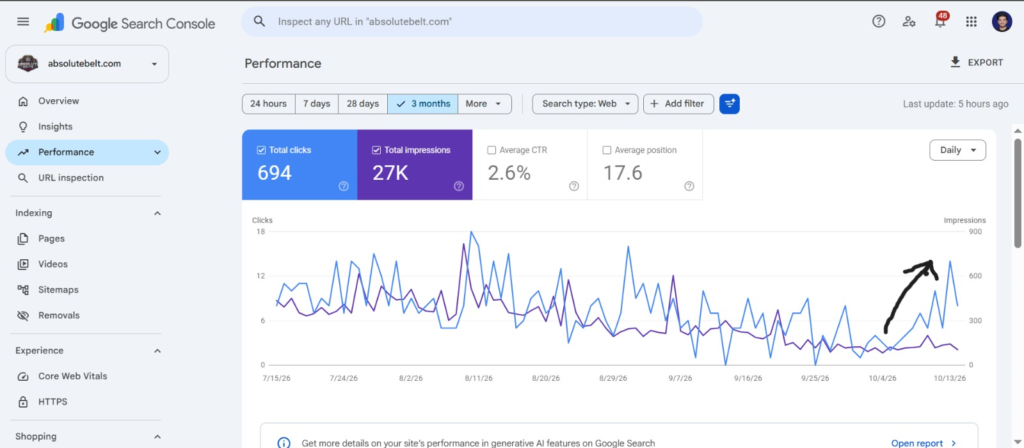
In late September and October, the graph shows clicks and impressions rising again, with clicks reaching their highest daily levels since the decline began.
Results Summary
- Before (early launch): Near-zero clicks and impressions
- Growth peak: Up to 1.8K daily impressions and 33 daily clicks
- Decline phase: Daily clicks fell to low single digits and low double digits
- Recovery phase: Upward trend in clicks and impressions after the content and linking work began
- Insert if available: keyword counts in top 3 / top 10, indexed page count before and after, PageSpeed scores before and after
Key Lessons
- Basic on-page SEO can produce fast early traction for a new site.
- Adding many product pages without managing speed and quality can hurt the whole site.
- Consistent NAP across the website, GBP, and social profiles supports trust and local visibility.
- Thin content outside the product pages can cause a decline just as much as thin product pages can.
- Internal linking should follow topical logic, not convenience.
- Pruning low-value URLs and rewriting content helps recovery, and topical clusters sustain it.
Next Steps
- Finish the remaining content rewrites
- Complete the topical clusters and connect them with clean internal links
- Monitor indexing, rankings, and Core Web Vitals monthly
- Report on results again once the full cluster is live